What to Eat to Reduce the Risk of Breast Cancer Coming Back

Updated: Sep 1
By Dr. Lena Suhaila, ND, FABNO
What do I eat? It's the question I hear more than any other in this practice, and the research now points in a clear direction for most women. The single most useful change is lowering your fasting insulin, and the fastest way there is cutting refined carbohydrates while building meals around protein, healthy fats, cruciferous vegetables, and whole fermented soy. In the DIANA-5 trial, which was null overall, the third of women who improved their diets the most had 41% lower recurrence than the rest. Food is the lever you use to change the environment your tumor biology lives in, and it responds in weeks, not years.
Food turns out to be one of the most powerful things you've got. Read the research carefully, past the headlines and into the findings themselves, and the direction it points is unusually clear for most women. Cancer biology is responsive to what surrounds it. The metabolic environment your body keeps day to day is something you build, three or four meals at a time, with your hands.
Change the environment, change the outcome
Tumor cells don't live alone. They live inside a microenvironment of immune cells, blood vessels, hormones, metabolites, signaling molecules, and inflammatory mediators that either support them or don't. Modern oncology calls this the tumor microenvironment. Paget called it the soil, back in 1889, and noticed that cancer cells (the seeds) only take hold when the soil is hospitable. The same cancer cell line transplanted into different microenvironments behaves completely differently. Same seed, different soil, different outcome.
You can't reach in and change the cells directly. You can change the environment they're in. Insulin, blood glucose, inflammatory markers, oxidative stress, the bacteria in your gut, your cortisol patterns, the fatty acid composition of your cell membranes. These respond to what you eat, how you sleep, how you move, and what you let into your body. This is the same terrain-first thinking I lay out in Food as Metabolic Medicine.
The work in this article isn't really about food. Food is the lever you use to change the environment your body runs. When the DIANA-5 women changed how they ate and recurrence dropped 41%, what changed was their body's internal environment, and tumor biology responded to it.
Insulin is the most useful number nobody put on your labs
Your fasting insulin is probably the most modifiable number in your whole metabolic picture, and arguably the one with the most leverage for long-term protection. It responds to what you eat in weeks, not months. Drop it and the whole environment around your tumor biology changes. The glucose side of this same story is in What Your Blood Sugar Has to Do With Cancer.
Insulin activates the same growth pathways breast cancer cells use to multiply, especially the IGF-1 and PI3K/AKT/mTOR signaling that drives ER-positive proliferation. It raises aromatase activity in fat tissue, which means more local estrogen production happening right where breast tissue lives. It lowers SHBG, the protein that binds estrogen and keeps it inactive, so more of your circulating estrogen ends up biologically active. It sustains the low-grade inflammation that surrounds tumor biology in the first place. Cut insulin and you've cut the loop on every one of those.
DIANA-5, published in Clinical Cancer Research in 2024, enrolled 1,542 Italian women at high recurrence risk because of metabolic syndrome, elevated insulin, or elevated testosterone. The trial as a whole came back null. But when the researchers looked specifically at the women who changed how they ate, the ones in the top third of dietary improvement had 41% lower recurrence than the rest. [1] The diet works in the women who do it.
The most powerful intervention for lowering fasting insulin is carbohydrate restriction. Within two to four weeks of consistently cutting carbohydrates, fasting insulin drops measurably in most women. Everything else flows from there.
Fasting insulin belongs on every breast cancer survivorship lab panel. Optimal for cancer protection is 2 to 3 uIU/mL. Anything above 3 starts pulling away from optimal. Above 6 you're seeing early metabolic dysfunction. Above 10 is significant insulin resistance. A lot of women in the 4-to-10 range have been told their labs are normal. Normal is a population average. Optimal is a different number.
Your subtype changes the answer
Breast cancer isn't one disease. Hormone-positive ductal in a sixty-five-year-old with central adiposity has different biology than triple-negative in a thirty-six-year-old who's already lean. Lobular is its own animal entirely. The diet that's right for one of these women would be wrong for the next.
ER-positive ductal cancer (about 70% of diagnoses)
ER-positive tumors run on estrogen and insulin, and the two feed each other. Insulin pushes aromatase activity in fat tissue and lowers SHBG, which together raise both the production and the bioavailability of the estrogen your tumor biology responds to. Cut insulin and you've cut the loop on both ends.
How aggressively you cut depends on where you start. Fasting insulin already at 3, body composition solid, metabolic markers clean: a low-carbohydrate Mediterranean approach is plenty, and the DIANA-5 finding lives here. The Italian women who changed how they ate had 41% lower recurrence than the women who didn't.
Fasting insulin elevated, central adiposity, metabolic syndrome on paper: the case for going further into ketogenic territory gets stronger. There's no large RCT proving keto specifically reduces early-stage ER-positive recurrence, and I'll say that plainly. What there is is the biology, plus benefit shown in adjacent populations (the Iranian breast cancer trials, the Cohen ovarian and endometrial trial), plus what the mechanism predicts. Insulin drops. Visceral fat melts. Inflammatory markers come down. The women you'd predict to benefit, do.
Invasive lobular cancer (10 to 15% of diagnoses)
Lobular doesn't follow ductal's five-year arc. It follows a thirty-year one, sometimes longer. The cells stay dormant in places conventional surveillance has trouble seeing, peritoneum and bone and GI and ovary, and when they surface, they surface into whatever metabolic environment your body has been keeping. Year ten. Year fifteen. Year twenty.
So the question isn't really how long you eat this way. It's that what you eat at fifty-eight is what your tumor biology meets, if it ever surfaces, and the women who do best with lobular are the ones who stop trying to graduate from the protocol and start treating it like the way they live.
Triple-negative breast cancer
Triple-negative is where keto data sits strongest. TNBC tumors run on glucose more dependently than hormone-driven cancers. They're more glycolytic, meaning the Warburg effect is doing more of the work. The Khodabakhshi trials out of Iran in 2020 paired keto with chemotherapy in breast cancer patients including TNBC, and the keto arm came out with better disease-free intervals and better quality-of-life scores. [7,8]
The biology underneath is straightforward. TNBC has fewer good targets conventionally. No hormone receptor to block. No HER2 to chase. Cutting the glucose supply the tumor runs on is one of the few metabolic strategies available, and it goes after the cancer's actual fuel.
Caveat: body composition counts here more than anywhere else. A woman who came out of treatment underweight and depleted shouldn't go aggressive low-carb. Moderate low-carbohydrate Mediterranean, calories adequate, protein toward the upper end of cancer guidelines (1.2 to 1.5 grams per kilogram of actual body weight), resistance training to rebuild what treatment took. Different patient, different version.
HER2-positive breast cancer
HER2 signaling responds to insulin and IGF-1, so the metabolic case applies here too. Patients on trastuzumab who also have weight gain from treatment or metabolic dysfunction respond well to carbohydrate restriction. Cardiac function monitoring sits alongside the metabolic work, and a Mediterranean-leaning ketogenic approach (heavy on olive oil, fatty fish, leafy greens) covers both pieces.
What this looks like on a Tuesday
Principles get real when you can see them on a plate. Three days, three different patients, each one a real-life version of what these subtype-specific approaches look like.
A day for an ER-positive woman with metabolic dysfunction on a ketogenic approach
Morning. Three pasture-raised eggs scrambled in olive oil with sauteed spinach, half an avocado, and a small handful of berries. Black coffee or green tea.
Midday. Wild salmon over a bed of arugula, dressed with extra virgin olive oil, lemon, and fresh herbs. A few macadamia nuts and a quarter cup of pumpkin seeds on the side.
Evening. Grass-fed and grass-finished lamb with roasted broccoli, cauliflower, and Brussels sprouts in olive oil and herbs. A side of fermented vegetables.
If hungry between meals. Olives, a few slices of A2 cheese (sheep, goat, or grass-finished Jersey), half an avocado with sea salt, or a small portion of sardines.
A day for a healthy-weight ER-positive woman on a low-carbohydrate Mediterranean approach
Morning. Plain whole-milk Jersey or sheep yogurt with ground flaxseed, walnuts, cinnamon, and a small handful of berries. Green tea.
Midday. A large salad with mixed greens, organic tempeh or wild sardines, cherry tomatoes, cucumber, red onion, sheep feta, and a generous olive oil and lemon dressing.
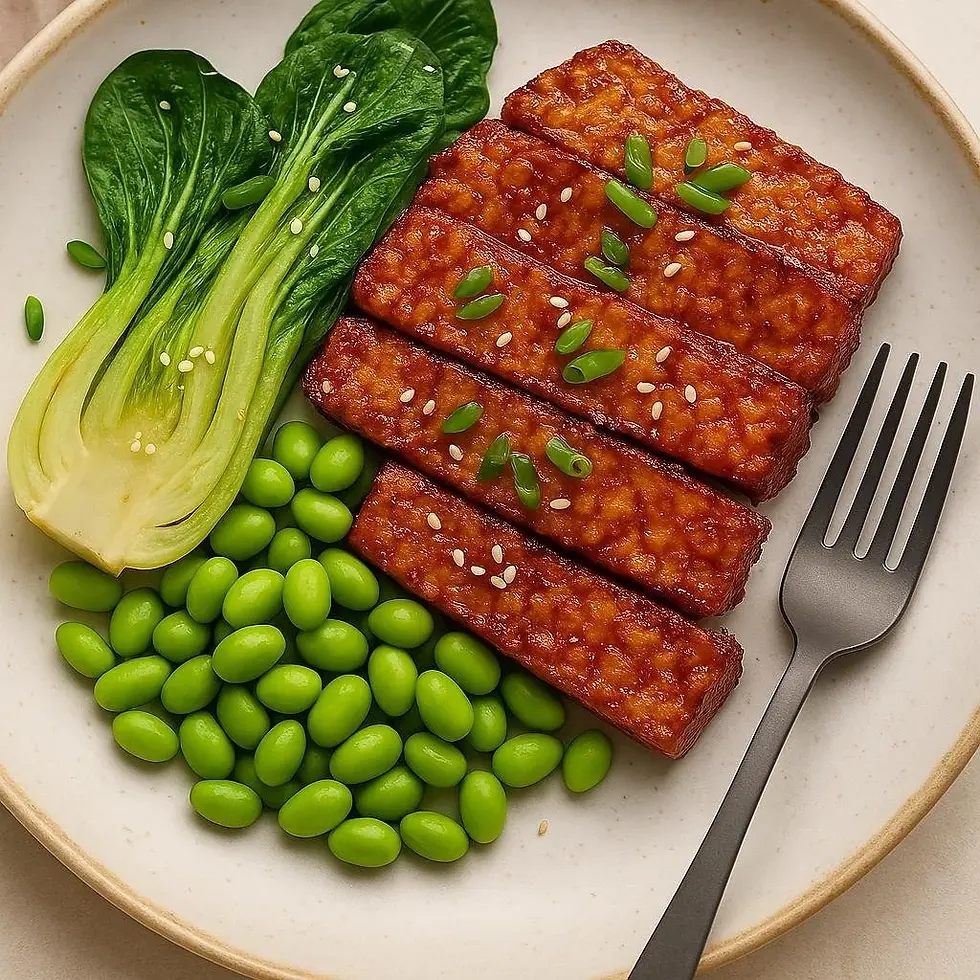
Evening. Baked white fish with roasted Mediterranean vegetables (eggplant, zucchini, peppers), a small portion of organic tempeh or miso-marinated tofu, a side of garlicky sauteed greens, all finished with olive oil.
If hungry between meals. Olives, a small handful of almonds, organic edamame, a hard-boiled egg, or vegetables with hummus.
A day for a triple-negative patient recovering from significant weight loss
Morning. Three eggs in pasture butter with avocado, sauteed greens, and a small portion of sweet potato or steel-cut oats with cinnamon and walnuts for sustained calories.
Midday. A larger protein portion (6 to 8 oz of wild salmon or grass-finished beef) with quinoa or wild rice (small portion), olive oil, roasted vegetables, and tahini.
Evening. A generous portion of slow-cooked grass-finished beef stew with abundant root vegetables, herbs, and homemade bone broth. Green salad on the side.
Between meals. Calorie-dense snacks: nut butter on apple, full-fat A2 yogurt with seeds and a touch of honey, or a smoothie with avocado, almond butter, and clean protein powder. The goal is rebuilding lean mass without overspiking insulin.
The questions every patient asks
Is soy safe?
Yes, with conditions, and the conditions count more than the headline answer. The 2024 JNCI Cancer Spectrum meta-analysis found soy isoflavones associated with a 26% recurrence reduction, with the strongest protection in postmenopausal and ER-positive women, at around 60 mg of isoflavones a day (two to three servings of whole soy food). [2]
The form counts as much as the dose. Fermented organic soy (tempeh, miso, natto, traditional shoyu) is the gold standard, because fermentation pre-digests the isoflavones into more bioactive forms and the form delivers probiotics alongside the protective compounds. Whole organic soy (edamame, organic tofu, organic soy milk) comes next. Skip soy protein isolate, soy protein concentrate, conventional non-organic soy, and the processed soy meat substitutes. About 95% of US soy is GMO Roundup-Ready and sprayed with glyphosate, which disrupts the gut microbiome and drives inflammation. The protection in the literature was demonstrated in populations eating whole-food, traditionally-prepared, often fermented soy. It was not demonstrated in the soy isolate that fills American grocery shelves.
There's also a microbiome question that determines how much benefit any of this delivers for your body specifically. Whether your gut bacteria can convert daidzein (the soy isoflavone you swallow) into equol (the protective metabolite) depends on the specific microbial population you've developed over a lifetime, and only 20 to 35% of Western women are equol producers compared to 50 to 70% of Asian women. That changes the equation. I wrote a separate piece on the microbiome and soy for women who want to go deeper.
What about dairy?
Dairy depends entirely on which cow.
Conventional American dairy comes mostly from Holsteins, which produce milk containing A1 beta-casein. Digesting A1 milk produces a peptide called BCM-7. It's pro-inflammatory, has opioid-like effects on the digestive tract, and drives most of the symptoms women blame on lactose. A lot of self-diagnosed lactose intolerance is A1 intolerance. The same person can drink sheep milk or A2 cow milk without symptoms. [9]
Older European breeds, Jersey and Guernsey, produce only A2 beta-casein. So do sheep, goats, and water buffalo. A2 dairy is better tolerated, less inflammatory, and easier on the gut.
Then there's what the cow ate. Grass-fed and grass-finished aren't the same. Grass-fed only requires grass during part of life. Grass-finished means grass through the lactation period or the final weeks before slaughter. Grass-finished dairy gives you higher omega-3, more CLA, more vitamin K2, lower omega-6 to omega-3 ratio. Grain-finished gives you the opposite, plus residues from whatever feed and treatments the cow received in the feedlot.
Worth eating: full-fat, fermented when you can, A2 from grass-finished animals, or sheep, goat, or water buffalo. Plain whole-milk Jersey yogurt, sheep yogurt, kefir, raw or properly aged cheeses from grass-finished animals, real ghee. Skip anything labeled low-fat or fat-free, anything from conventional Holstein operations, anything with added sugar, ultra-pasteurized products, and the seed-oil-laden lite dairy marketed at women.
If you have true lactose intolerance (missing the enzyme that breaks down milk sugar), that's a separate issue from A1 intolerance. The answer there is fermented dairy where bacteria already broke down the lactose, aged cheeses where lactose is minimal, or just skipping dairy. But before you assume it's the lactose, try A2. A lot of women find out the problem was the cow.
What about alcohol?
The incidence picture is straightforward. Every 10 grams of alcohol a day, roughly one drink, raises breast cancer incidence by about 10%. Linear, dose-dependent, well-established. [3]
The recurrence picture is less tidy. The 2026 Arecco meta-analysis, 37 studies and over 2.5 million women, didn't find a significant association between post-diagnosis alcohol consumption and recurrence or breast cancer-specific mortality. [4] Some women read that as "a glass of wine is fine." I read it differently. Alcohol is a known carcinogen, the precautionary principle applies, and there's no biological argument for why a substance that raises incidence stops counting after diagnosis.
There's a separate layer of this most American women have never heard about. Most US wine, including wine labeled organic or biodynamic, tests positive for glyphosate residue. California especially. The glyphosate often isn't from the vineyard itself. It comes from drift off neighboring conventional vineyards or general agricultural contamination. So a glass of California Cabernet often pairs ethanol with a small dose of a known endocrine-disrupting herbicide.
If you're going to drink, two practical adjustments. Keep it occasional rather than daily. And if wine is your choice, European wines from countries with stricter agricultural regulation (France, Italy, Spain, Germany), and especially organic or biodynamic European wines, carry lower glyphosate burden than California wines.
What about intermittent fasting?
Longer fasting windows do more.
The Marinac study in JAMA Oncology in 2016 showed women who fasted fewer than 13 hours overnight had a 36% higher risk of breast cancer recurrence than women who fasted 13 hours or more. [5]
Sixteen hours pulls insulin down further than 13. Eighteen further than 16. Periodic 24-hour fasts add another layer of mTOR suppression and the cellular cleanup processes that help your body clear damaged cells before they accumulate. For women who tolerate it, the fasting-mimicking diet developed by Valter Longo's lab at USC has cancer trial data, which I cover in Fasting During Chemotherapy.
Practical translation for healthy-weight women in survivorship: a daily 14- to 16-hour fast (eating between roughly 11am and 7pm) is sustainable and effective. One or two longer days a week, eating in a 6-hour window or skipping a meal entirely, layers benefit on top. The longer you can comfortably hold a longer fast, the more it's working.
Caveats count. Fasting protocols are not for women who are underweight, recovering from significant treatment-related weight loss, at cachexia risk, or who carry an active or past eating disorder history. For these women, regular nutrient-dense eating is the priority. The intervention has to match the woman in front of you.
Duration counts as much as what you eat
A 2023 case series from Osaka University Hospital, published in Nutrients, followed advanced cancer patients on a structured ketogenic diet for up to ten years. The patients who stayed on the diet at least 12 months had significantly better overall survival than the ones who didn't, even after adjusting for confounders with inverse probability of treatment weighting. [6]
The Osaka cohort was stage IV, various cancer types, not specifically breast. So the absolute numbers shouldn't get over-extrapolated to early-stage women. But the principle shows up across cancer biology. This is a long-term tool, not a six-week cleanse. The women who get the best outcomes change how they eat permanently and stop treating it as an intervention.
DIANA-5 said the same thing in different language. Average across the trial, no signal. Look at the women who changed how they ate and stayed changed, big signal.
Why this is hard, and why that's not a moral failing
Changing how you eat is hard, and that's not a character flaw. Food isn't calories. Food is identity. Food is family. Food is the way your mother showed love. It's how you celebrate. It's what you reach for after a hard appointment. So when we talk about changing how you eat, we're talking about changing something that lives in the deepest layer of how you experience being yourself.
Cancer treatment was already an enormous loss. Time, hair, energy, sleep, certainty. Asking you on top of that to change how you eat, especially if you come from a culture where food is the language of love, is not a small ask. It's not weakness if you cried over a pasta dinner. It's not lack of commitment if you've started and stopped three times.
What changes the equation is partnership. The science isn't too complicated for you. You don't lack the discipline to do this on your own. The reason it tends to work better with someone in your corner is that identity work happens better in relationship than in isolation. The women in DIANA-5 who got the 41% protection were the ones who changed how they ate and stayed changed. What I see, in practice, is that the women who succeed long-term tend to have someone alongside them who knows the science, knows them specifically, and keeps adjusting the plan as life keeps happening.
What you'll feel before recurrence risk ever shows up on a chart
Recurrence prevention is a long-term outcome you can't feel. What you can feel, usually within four to six weeks, is everything else.
Energy stops crashing in the late afternoon. Sleep deepens because blood glucose stops dropping at three a.m. and waking the cortisol response. The cognitive fog that lingered after chemotherapy lifts because ketones are a more stable fuel for the brain than glucose was, and the inflammation pulling on your nervous system goes down. Joint pain from aromatase inhibitors eases. Hot flashes often improve in the first month, which surprises most women. Anxiety lifts because blood sugar instability is one of the most overlooked drivers of anxious arousal in women over fifty. Body composition shifts in a direction most weight loss approaches don't produce, with visceral fat going first. Lymphedema, when it's there, often improves because inflammation drops.
These are the felt benefits that make the protocol sustainable. Recurrence prevention motivates you to start. The day-to-day quality of life is what makes you keep going.
Continue reading
Is Soy Safe After Breast Cancer? The microbiome story Western women rarely hear about soy and ER-positive breast cancer.
Ketogenic Diet for Cancer: A Naturopathic Oncologist's Full Guide. The full naturopathic oncology guide to ketogenic eating, indications, implementation, and clinical evidence.
Work with me
The article is the framework. The application is what I do with patients. I work one-on-one with women navigating breast cancer who want their care personalized to their actual biology. Your specific subtype, your treatment regimen, your medications, your lab values, your genetics, and the life you're trying to live through all of it. If that's what you're looking for, here's where to start.
References
Berrino F, Villarini A, Gargano G, et al. The Effect of Diet on Breast Cancer Recurrence: The DIANA-5 Randomized Trial. Clin Cancer Res. 2024;30(5):965-974. PMID: 37847493. PubMed
Boutas I, Kontogeorgi A, Dimitrakakis C, et al. Phytonutrients and outcomes following breast cancer: a systematic review and meta-analysis of observational studies. JNCI Cancer Spectr. 2024;8(1):pkad104. PMID: 38128031. PubMed
Sun Q, Xie W, Wang Y, et al. Alcohol Consumption by Beverage Type and Risk of Breast Cancer: A Dose-Response Meta-Analysis. Alcohol Alcohol. 2020;55(3):246-253. PMID: 32090238. PubMed
Arecco L, et al. Association between alcohol consumption and breast cancer incidence and prognosis: A systematic review and meta-analysis. The Breast. 2026. ScienceDirect
Marinac CR, Nelson SH, Breen CI, et al. Prolonged Nightly Fasting and Breast Cancer Prognosis. JAMA Oncol. 2016;2(8):1049-1055. PMID: 27032109. PubMed
Egashira R, Matsunaga M, Miyake A, et al. Long-Term Effects of a Ketogenic Diet for Cancer. Nutrients. 2023;15(10):2334. PMID: 37242217. PubMed
Khodabakhshi A, Akbari ME, Mirzaei HR, et al. Feasibility, Safety, and Beneficial Effects of MCT-Based Ketogenic Diet for Breast Cancer Treatment. Nutr Cancer. 2020;72(4):627-634. PMID: 31496287. PubMed
Khodabakhshi A, Seyfried TN, Kalamian M, et al. Does a ketogenic diet have beneficial effects on quality of life, physical activity or biomarkers in patients with breast cancer. Nutr J. 2020;19(1):87. PMID: 32828130. PubMed
Pal S, et al. The A1/A2 milk debate: a comprehensive review of beta-casein digestion and health implications. Crit Rev Food Sci Nutr. 2022. PubMed